Global Nail Masters
/
Rules & regulations

How the championship works.

The official competition regulations, in full. These rules are for competitors and judges — please read the section for each discipline you enter.

Contents
General & structure
Hands-on competitions
Submitted competitions
General & structure
2.1.1

General Rules

  1. 1INJA competitions are open to students and professional nail technicians.
  2. 2The competitions are open to those who satisfy the requirements and applies to the competition properly.
  3. 3As an international competition participant, the competitor must respect all rules and manners of competition.
  4. 4Universal and commonsensical standards will apply to other manners or rules not specified in the INJA rules.
  5. 5All competitors will be disqualified if they intentionally or recklessly apply to a lower division then the actual division they belong in.
  6. 6All competitors will be disqualified and banned from all future INJA and Nailympion competitions globally, if they are caught cheating at the time of any of the competitions.
  7. 7Competitors must specify the division for each classification they are entering when the application form is completed. Once the competitor has registered, they can not change divisions without direct permission from the head judge or INJA supervisor.
  8. 8The competitor must enter the highest division they qualify for.
  9. 9Due to the large attendance of international competitors, INJA and the competition organization is not responsible for verifying that each competitor enters into the correct division.
  10. 10INJA and the competition's organization reserves the right to refuse entry to any competitor.
  11. 11There are no refunds of competition fees
  12. 12Competition fees are non-transferable
  13. 13All photos and videos taken by INJA and the competition's personnel or hired contractors are the sole property of INJA and the competition's organization to be used in whatever fashion deemed appropriate by them without compensation to the competitors and models.
  14. 14Competitors must use a live model and arrange for the model themselves. They are also allowed to used their own hand if they choose.
  15. 15Competitor and Models must be at least 18 years old for divisions 1,2&3. If under 18 express permission from parent/ guardian
  16. 16INJA and the competition's organization is not responsible for any competitor not adhering to or understanding all of the rules.
  17. 17There is no smoking, drinking Alcohol or eating allowed on the competition floor unless allowed by organizer prior to the competition.
  18. 18No mobile phones, tablets or computers of any kind on the competition floor during the competition for both the competitor and the model. No Apple iWatch or Samsung watches that can be used to communicate are allowed.
  19. 19No outside communication with competitors while competitions are going on.
  20. 20Competitors may not be on the competition floor until the floor is open for set up. If the competitor is competing in the following competition, you may leave your table set up but must clear the floor until the arena judge opens it up for the next competitions set up.
  21. 21INJA and the competition's organization is not responsible for any competitor not adhering to or understanding all of the rules
  22. 22Only competitors and models are allowed to enter into the competition floor.
  23. 23Each competition will have a briefing 15 minutes prior to the start of the competition.
  24. 24All competitors and models must be present for the briefing.
  25. 25Once the briefing of a competition begins, the competitor may not touch the models nails until the competition begins. If anyone or any competitor touches the models nails after the briefing and before the competition begins, there will be a 5 point deduction from their final score.
  26. 26Models nails will be checked by the arena judge after the briefing to be certain no application has been done prior to the start of the competition.
  27. 27Competitors allowed to prepare the natural nail prior to the competition. But absolutely no application work of any kind until the competition officially begins.
  28. 28If it is decided by the floor head arena judge that application work has been done on the model prior to competition, the competitor will receive a 5 point deduction to their final score.
  29. 29Competitors are allowed to set up table, products and supplies during the competition briefing
  30. 30Competitors or models may not go into their kits once the competition has started without permission from an arena judge
  31. 31All products being used during the competition must be clearly labeled. Hand written labels are acceptable.
  32. 32Competitors must bring all of the necessary electrical supplies, including UV/LED lamps, extension cords, adapters, electric files and table lights.
  33. 33Each competitor will be provided one electrical outlet.
  34. 34Competitors must provide their own products
  35. 35Strictly no molds ( Dual Forms) that create a well shaped nail may be used for any of the competitions.
  36. 36Once the allotted time is up the competitors must immediately stop working and put their hands up. The model must stand up and get in line for judging immediately.
  37. 37Competitors caught touching their models hands after the time has been called will receive a 10 point deduction to their final score
  38. 38Models may not wear any jewelry on their hands or wrist
  39. 39When instructed, competitors are responsible for getting their model to the judging arena and making certain the model understands that they must be judged by all of the judges before leaving the competition arena.
  40. 40Models must not leave the judging area until they have been completely judged.
  41. 41Any model that leaves the judging arena prior to being completely judged will be disqualified.
  42. 42Any competitor not abiding by these rules will take whatever point deduction is allowed in the rules. For any rules not specifying a point deduction, there will be one warning. The second infringement will be penalized by a 5 point deduction and the third infringement will be cause for disqualification of the competition.
  43. 43In the event of a tie or of any disputes to the scoring places first through ten, the head judge will make the decision.
  44. 44The head judges decision is final
  45. 45Score sheets will be made available for all competitors
  46. 46In the event that a competition only has 4 competitors, only 1st place trophy will be awarded.
  47. 47The competition must have a minimum of 3 competitors in it. If less than 3 competitors have entered, the competitor may choose to enter into a division in the next higher division or choose to pull out of it and get a refund on the competition fees. They may also compete to help earn points for the team trophy. If they have a minimum of 70% score they can receive a 3rd place trophy. If the score is 80% a second place trophy. First is not allowed to prevent division changes.
  48. 48The use of any type of fire or heating devices, which can ignite that are used directly on the model during the application or curing process is prohibited on the competition floor for all of the competitions.
  49. 49The competitor is allowed to bring a small trolly or something that can be used as an extra table to put extra items on top when necessary due to small tables that are sometimes provided.
  50. 50The competitor can put all the needed items in a open box that be placed on top of the competitors nail kit.
  51. 51There is absolutely no touching of the models once the models are lined up in the Q for judging.
  52. 52Once the briefing begins the model's hands must be on the table and the competitor's hands must be placed on their laps under the table.
  53. 53There will be a 5 point deduction for any violation of the any of the rules.
2.2

Division Rules

Division rules

Division 1: (Is subdivided in two)

A. Division 1: First Timers

For those who have never competed in any type of competition Hands On in their lives.

This beginners division was created so that those who compete for the first time do not compete with those who already have experience in competition arena . The 1st place in each category will go on to the 2nd division in the next competition.

You can only participate in a competition as a beginner, in the 2nd experience if the competitor does not get a 1st place, he will go to the 1st division.

B. Division 1:

For competitors who have never tropyed in Division 1 or 1st timers Hands On (or equivalent category).

For competitors who have experience in any other competition in Hands On categories.

- For competitors who have never trophy in Division 1 in a Hands On Competition* .

- For competitors who have won 1st place in any INJA competition in the Student Division and are still subject to the Division Student Rules.

Division 2:

For competitors who have competed in any Hands On * and/or internationally recognized competition ** and have obtained a 1st 2nd or 3rd place in Division 1 of 1st timers 1st tropyes. For Winner of the Winners First Timers and div 1.

Division 3:

For participants who won 1st place in a Hands On* and/or internationally recognized ** Division 2 and 3 competition of any INJA competition. Winners of "Winner of the Winners" Division 1 and 2. Winners of the "Grand Champion", regardless of division.

*Hands On Competition: Any competition where the competitor creates the nails during the competition time and not before.

**International Recognized Competition: All competitions that are not linked to a distributor or brand and that its jury is made up of at least 50% of judges from other countries that have been invited.

The competitor must be able to prove that the division in which he enters is correct.

2.2.1

Division, Champion & Team Trophy Rules

Student Division

This division is open to any student that is either currently enrolled in nail school or who have received certificates for completing basic courses and/or exams dating back from one year prior to the date of the competition. Every country the dates are altered to reflect proper timeline.

First Timers Division

For people who have NEVER COMPETED in any competition in their life.

Competitors from First Timers Division will follow the same rules as competitors from Division 1.

Those that win 1st place in first timers will go to Division 2 the following competition

Division I

For competitors who have never placed 1st in any *Hands - on **Internationally recognized competition in Division 1.

Competitors that have taken 2nd or 3rd place trophy in Division 1 at any INJA certified competition.

For competitors who have placed 1st at any INJA certified competition in STUDENT divisions and still qualify under the rules for students.

Division II

For competitors who have competed in any *Hands-on **Internationally recognized competition and have placed in 1st in division 1 and placed 2nd or 3rd for division 2 at any INJA certified competition. Winners of Winners, First Timers Division

Division III

For competitors that have placed 1st in any *Hands-on **Internationally recognized competition and

1st at any INJA certified competition in division 2 & 3

For competitors who have won Division 1&2 "Winner of Winners"

And for any competitor, regardless of division who has won "Grand Champion"

Gobal Championship Division

For competitors who have taken first place in Division III at any INJA certified competition, Winner of Winners for Division III. Grand champions and all Nail Art champions from Nailympics and

Nailympion

**Hands-on Competitions

Any Competition where the competitor is creating the nails during the time of competition and not done prior to the competition.

*Internationally Recognized Competitions

All competitions that are not a distributor or brand name competition. A competition wherein 50% of the judges come from another country where the competition was located.

Proof of division should be provided for all competitors when asked.

Division Winner of Winner Qualifications

To qualify for Winner of Winners trophy the competitor must compete in a minimum of 3 of the hands-on competitions at the event.

The winner will be determined by the a combined total score of the competitors top 3 scores of the qualifying competitions.

Grand Champion

This trophy is open for divisions 1,2 &3 to enter. To qualify, the competitor must compete in all of the hands on competitions. OR they can compete in the French Sculpture Acrylic, French Sculpture gel, traditional gel manicure competitions, and minimum 2 of the competitions hands on of the event. The champion will be determined by the total scores of all of the competitions combined.

Team Trophy

Team trophy is top 3 of the hands on competitions. To qualify for the Team trophy there must be a minimum of 3 and maximum of 6 competitors entered.

The competitors may be in any of the 3 divisions. The scores will be combined from all of the hands on competitions. French Acrylic Sculptured, French sculptured Gel, French Twist, Design Sculptured,

Ultimate Nail art Challenge and Fashion Design Soak-off Gel Manicure.

The top 3 scores from each team will be used to make the total score. It is free to enter a team.

Student Team Trophy

Student team trophy; all 4 competitions must be entered by a minimum of 3 and a maximum of 6 competitors.

The scores will be combined from all 4 of the hands on competitions.

The top 3 scores from each team will be used to make the total score. It is free to enter a team.

Submitted Nail Art

Division I

For competitors who have never placed 1st in any *Submitted Nail Art competitions at any INJA certified competition and **Internationally recognized competition in Division 1.

Competitors that have taken 2nd or 3rd in Division 1.

For competitors who have placed 1st at any INJA certified competition in STUDENT divisions and still qualify under the rules for students.

Division II

For competitors who have competed in any *Submitted Nail Art at any INJA certified competition

**Internationally recognized competition and have placed in 1st in division 1 or placed 2nd or 3rd for division 2.

Division III

For competitors that have placed 1st in any * Submitted Nail Art*at any INJA certified competition

*Internationally recognized competition and 1st at any INJA certified competition in division 2 & 3

For competitors who have won Division 1&2 Nail Art Champion

Nail Art Champion

Divisions 1,2&3 will each have its own Nail art champion. To qualify, all competitors must compete in

Fantasy Nail Art tip box, Mixed Medi and a minimum of 2 of the 4 other submitted nail art competitions. For example; Salon Trend Art tip box, Flat Art tip box , living art or rhinestone nail art.

The champion will be determined by the total score that combines all 4 scores together.

**Submitted Nail Art

Any competition where the work is done prior to the competition and turned in to be judged or is put onto a model for display.

*Internationally Recognized Competitions

All competitions that are not a distributor or brand name competition. A competition wherein 50% of the judges come from another country where the competition was located.

Proof of division should be provided for all competitors when ask.

Proof of division must be provided for all competitors when they complete their registration.

The competitor is responsible for registering in the correct division and must demonstrate that the division in which they are registered is correct. The organization requires that the competitor provided evidence that they have entered the correct division.

A competitor will be automatically disqualified if they have intentionally or recklessly registered in the wrong division to which they actually belong.

Competitors will submit a list of all competition trophies they have earned, and the organizers will assist the competitors for registering in the correct division.

© 2016 Copy INJA International Nail Judge Association - All Rights Reserved

2.3.1

Hands-On Competition Criteria

Judges Instruction for Nail Structure Categories

Convex

  1. The outer edge of the nail structure should be completely symmetric throughout zone 2 & 3.
  2. The outer edge of the nail should be consistent in appearance. It should appear completely even from every perspective within zone 2 and zone 3.
  3. The judge will examine the nail by looking at it from two different perspectives. The front and back side to check both zone 2 & 3.
  4. FRENCH COMPETITIONS & ONE Tone: The nail can earn a 1 point for each correct zone.
  5. Total of 2 possible points for each nail
  6. HAND-ON ART COMPETITIONS: The nail can earn ½ point for each correct zone.
  7. Total of 1 possible point for each nail

Concave

  1. The Concave Is located on the nail's extension. It is the interior portion of the free edge extension. This portion of the nail extension’s interior contour or tunnel of the extended free edge must be completely symmetrical within zone 3 and concentric at the Crown which is located where the Natural’s nail Distal Edge is located. This is commonly located where zone 2 ends and zone 3 begins. The location where the nail form or tip makes contact with the natural nail.
  2. The extended Free edge should have the appearance of the inside of a tunnel throughout it.
  3. Each nail that is judged will earn a score if the Concave is concentric where the Free edge begins. It should not appear to have a form that was applied to allow for excessive product. The form is applied completely following the nail’s Distal Edge.
  4. Each nail that is judged will earn a score if the Concave is symmetric throughout the free edge. There should not be any inconsistencies in the formation of the Free edge’s “tunnel”
  5. FRENCH COMPETITIONS & ONE TONE: The nail can earn a 1 point for each correct criteria.
  6. Total of 2 possible points for each nail
  7. HAND-ON ART COMPETITIONS: The nail can earn ½ point for each correct criteria.
  8. Total of 1 possible point for each nail

Arch and Apex

  1. The high point (Apex) of the entire nail should appear in zone 2 to earn 1 point.
  2. See example of zone 2
  3. The apex must not be too flat or too high. It should be subtle with a gradual incline to earn 1 point.
  4. Each nail that is judged will earn a score for the location of the arch and a score for the correct appearance of the apex.
  5. FRENCH COMPETITIONS & ONE TONE: The nail can earn a 1 point for each correct criteria.
  6. Total of 2 possible points for each nail
  7. HAND-ON ART COMPETITIONS: The nail can earn ½ point for each correct criteria .
  8. Total of 1 possible point for each nail

Form Fit

  1. The form should be applied correctly to make a proper structure.
  2. The form application must be applied without any space between the distal edge and nail plate.
  3. If the form’s application is correct, there will not be any space where Zone 2 ends (natural nails Distal Edge) and where Zone 3 begins (beginning of the extension).
  4. The product must cover the distal edge, and the nail groove that is beneath the lateral folds.
  5. The nails extension should not have any visible notches or gaps on the lateral side folds where the free edge extension begins.
  6. The nail can earn a score for each side of the nail.
  7. FRENCH COMPETITIONS & ONE TONE: The nail can earn a 1 point for each correct side.
  8. Total of 2 possible points for each nail
  9. HAND-ON ART COMPETITIONS: The nail can earn ½ point for each correct side .
  10. Total of 1 possible point for each nail

Tip Application

  1. The tip application must be applied to fit the nail properly. This means that there is absolutely no space between the natural nail groove and the tip. There should be not space between the Lateral fold and the nail extension’s sidewalls.
  2. The location in which the tip is applied should also be considered. The tip must have proper placement and not be to far down on the nail plate or too far up, exposing the natural nail line. It should be applied with 1-2 mm onto the nail plate.
  3. The size selection must also be correct. It shouldn’t be too small or too large.
  4. The judge will examine each nail on both sides. The area where the distal edge and nail groove is where they will check to see that the tip is be properly located and fits properly.
  5. FRENCH COMPETITIONS & ONE TONE: The nail can earn a 1 point for each correct side.
  6. Total of 2 possible points for each nail
  7. HAND-ON ART COMPETITIONS: The nail can earn ½ point for each correct side.
  8. Total of 1 possible point for each nail

Free Edge Thickness

  1. The free edge extension should not exceed more than 1.5mm (French Acrylic 1 mm) measurement in the location where Zone 2 and Zone 3 meet.
  2. The caliper measuring tool will be used directly after the Distal edge in the center of the nail to confirm the thickness is correct to earn a score.
  3. The nail must be consistently thin throughout the nails free edge and measure the same on both sidewalls that match the center to earn a score.
  4. The caliper measuring tool will be used on each sidewall to confirm the thickness is the same as the center.
  5. FRENCH COMPETITIONS & ONE TONE: The nail can earn a 1 point for each correct criteria.
  6. Total of 2 possible points for each nail
  7. HAND-ON ART COMPETITIONS: The nail can earn ½ point for each correct criteria.
  8. Total of 1 possible point for each nail
  9. See example of measuring tools used to measure the thickness.

Sidewalls

  1. Each side of the Free edge extension must appear straight from Zone 2 through Zone 3.
  2. The nail should not flare out or taper in when looking at the nail from the front perspective.
  3. There should not be any ridges on either side the free edge extension.
  4. The sides of the free edges should feel smooth and appear to be filed correctly so that it isn’t ridged.
  5. FRENCH COMPETITIONS & ONE TONE: The nail can earn a 1 point for each correct side.
  6. Total of 2 possible points for each nail
  7. HAND-ON ART COMPETITIONS: The nail can earn ½ point for each correct side.
  8. Total of 1 possible point for each nail

Lateral Side Extension

  1. To find the lateral side extension you must look at the extension from the nails profile.
  2. The free edge extension must be straight on each side from where the natural nail’s groove wall and distal edge meet. This is the location where Zones 2 and 3 meet.
  3. The free edge extension should not drop down or appear to be tapered upward from the profile perspective.
  4. There should be no exposure of the natural nail's distal edge and Nail Groove.
  5. FRENCH COMPETITIONS & ONE TONE: The nail can earn a 1 point for each correct side.
  6. Total of 2 possible points for each nail
  7. HAND-ON ART COMPETITIONS: The nail can earn ½ point for each correct side.
  8. Total of 1 possible point for each nail

C-Curve

  1. The C-Curves must be a minimum 40% of a circle and no more than 50% to earn a score
  2. Each c-curve should appear to be a SEMICIRCLE to earn a score
  3. FRENCH COMPETITIONS & ONE TONE: The nail can earn a 1 point for each correct criteria.
  4. Total of 2 possible points for each nail

Nail Shape

  1. The shape of the nails must look consistent and uniform.
  2. The top of the Free edge must appear parallel. If it is filed correctly, it earns a score.
  3. The Free edge must look straight as it extends from the nail plate.
  4. The extension should be applied true to the natural nail. For example, if the finger is not straight and free edge extension will follow the direction of the finger. It should not be corrected to appear straight.
  5. The extension should be straight to the nail. Not straight to the finger.
  6. The hand will be turned around, so the free edge extension is examined from the front perspective.
  7. If the nail has been applied properly and the shape appears to look straight from the natural nail's grooves, the nail will earn a score.
  8. FRENCH COMPETITIONS & ONE TONE: The nail can earn a 1 point for each correct criteria.
  9. Total of 2 possible points for each nail
  10. HAND-ON ART COMPETITIONS: The nail can earn ½ point for each correct criteria.
  11. Total of 1 possible point for each nail

Consistency of Uniformity

  1. Each nail must look similar in shape to earn 1/2 point
  2. The shape of the nail individually should have the same degree of angle if shapes such as Stiletto, almond or edge is presented to earn a ½ point.
  3. Total point is 1

Surface Smoothness

  1. For all nails that have a Gel Topcoat to finish for for the shine: The application of the topcoat must be applied completely to cover the entire surface. There must not be any portion of the surface of the nail exposed and left unsealed. The judge will use a small LED light to check and make certain the application covers the entire surface of the nail. If it is completely sealed the nail will earn 1 point
  2. For all nails that have a Gel Topcoat to finish for shine: The judge will use their finger to feel the surface of each nail to confirm if in fact the surface feels smooth. Each nail must FEEL smooth on the entire surface with no air bubble or inconsistencies in the product application to earn 1 point.
  3. For all nails that have a High Shine Finish with Hand buffing: The entire surface of each nail must appear smooth. There should not be any visible files lines of demarcation that can be seen or any surface of the nail that looks unfinished. The judge will be carefully examining each nails entire surface. Nails that are completely free of imperfections on the surface and feel completely smooth will earn 2 points for each nail.
  4. If the judge examines the surface of the nail and see minor imperfections caused from unfinished buffing. Marks that can not be felt. Hard to see from more than one perspective. When this happens, the nail will earn 1 point.
  5. If the judge can see and feel file or application imperfections the nail will not earn any points.
  6. FRENCH ACRYLIC & GEL COMPETITIONS: The nail can earn a 1 point for each correct criteria.
  7. Total of 2 possible points for each nail
  8. SALON STYLE FRENCH (1 Hand Red 1 Hand French) the nail can earn ½ point for each correct criteria
  9. Total of 1 possible point for each nail
  10. HAND-ON ART COMPETITIONS: The nail can earn ½ point for each correct criteria.
  11. Total of 1 possible point for each nail

High Shine Finish

  1. For all nails that have a High Shine Finish with Hand buffing: the nail should have a high shine finish that is on the entire surface of the nail to earn 2 points.
  2. A high shine finish is when we see a reflection of light on the surface of the nail. The reflection of light should follow throughout the entirety of the surface of the nail. The judge will look at the nail and move it from side to side to help identify the reflection of light. If the nail is void of this reflection, it will not receive its points.
  3. If the judge sees a reflective glare across the table /top surface of the nail but it has surrounding areas they were not high shined well enough to pick up a reflexive light, it will earn 1 point.
  4. If the high shine finish is not covering the majority of the nail surface it will not earn any points.
  5. For all nails that have a Gel Topcoat to finish for shine: The Gel Sealer /Topcoat must be completely cured BEFORE the time is called. The finish must not feel or appear to be tacky or dull on the surface of the nail as a result of under curing. If the Gel Sealer has an inhibition layer, it is to be cleaned off. All of the tacky residue (inhibition layer) must be completely removed off of the nail to earn a score.
  6. The nails should have a high gloss shine that has a glass finish appearance throughout the entire surface of the nail and pick up a light reflection to earn a score
  7. FRENCH ACRYLIC & GEL COMPETITIONS: The nail can earn a 1 point for each correct criteria.
  8. Total of 2 possible points for each nail
  9. SALON STYLE FRENCH (1 Hand Red 1 Hand French) the nail can earn ½ point for each correct criteria
  10. Total of 1 possible point for each nail
  11. HAND-ON ART COMPETITIONS: The nail can earn ½ point for each correct criteria .
  12. Total of 1 possible point for each nail

Surface & Shine (One Tone)

  1. The nail should feel completely smooth on the surface to earn 1 point
  2. The gel sealer should be completely cured to a high shine to earn 1 point.

Product Control

French Competitions

  1. The application of the product should look evenly applied with a sharp division of color at the smile-line.
  2. There should not be a noticeable pink hue or shadow pulled over the white application.
  3. The White application of product should have a solid appearance throughout the entire free edge of the nail.
  4. If cover pink is allowed and used to create a nail plate extension, it should not be applied over the white application at the smile-line or be seen from the top view of the nail.
  5. There should not be any shadows or transparencies in the white or cover pink application.
  6. If you are using cover pink to extend the nail plate, the natural nail must not show or shadow in the extended nail. It is not necessary to extend the free edge when using cover pink to create the nail plate.
  7. There must not be any air bubbles and or pitting in the product.
  8. FRENCH ACRYLIC &GEL SCULPTURED 1 point is earned for the correct white application and a 1 point is earned for the correct pink application.
  9. SALON STYLE FRENCH ½ point is earned for white and ½ point for pink application

Hands-on art competition

  1. All of the product application should have a clean and well-defined application, and if glitter is used, control of application must be considered to earn a ½ point.
  2. There must not be any air bubbles and or pitting in the clear product to earn a ½ point.
  3. Total of 1 possible point earned for each nail

Cuticle Area (ZONE 1)

  1. The judge has two job to determine the final score given for each nail. The first portion will be focused on the surrounding skin (paronychium) . There is no ½ point given for these criteria.
  2. The second score is focused on the product application. It must be applied correctly. There shouldn’t be a large space between the skin and application. There should not be a large ledge of product that can be felt. This portion of the score ½ is allowed. Total score for correct application is 1 point
  3. The skin that surrounds the nail plate must be unharmed. All nail folds must not have any new and apparent cuts or abrasions to earn 1 point.
  4. There should not be any apparent ledge of product that can be felt or seen near the proximal folds to earn ½ point
  5. The application of product must be apparent and cover the entire cuticle area near the proximal fold without leaving a large margin between the cuticle line near the proximal fold.
  6. The product must not be overly filed and must be apparent to earn ½ point.

Hands-on competition

  1. Each nail must have all criteria to earn 1 point and 2 of the criteria to earn a 1/2 point.

Underside

  1. There should no dust, debris, water, glue or excessive oil on the back of the nail.
  2. The nail will earn 1 point for the nail to have a clean appearance
  3. The product application must appear smooth behind the nail with no excess product to earn 1 point for each nail.

Length

French Acrylic and Gel

  1. The nail is measured from the Cuticle to center of the smile-line to match the length of the top of the Free edge to the tips of the smile-line.
  2. If the smile points are not matching from side to side and one tip appears to be higher, measuring the length is considered to the higher (longest) smile tip.
  3. 1 point earned for each correct nail

Salon Style French (2 hands with red)

  1. The French nail is measured from the Cuticle to center of the smile-line. And then from the center of smile line to the top of the free edge.
  2. All measurements are done in the center of the nail.
  3. The white application should have a measurement of 50% of what the pink measurement is.
  4. For example: if the pink application measures 1 centimeter from the top of Zone 1 (where proximal fold is located) to the beginning smile line of the white. The white application should measure ½ centimeter from top of white line to the free edge.
  5. The second point is earned with both hands being measured together. The nails must also match hand to hand from cuticle to free edge to earn 1 point for matching fingers.
  6. The judge will be measuring the red hand next to the french and comparing the length from cuticle to free edge
  7. Each nail can earn 1 point for correct measurements

One Tone

  1. The nail is measured from the center of the proximal fold (cuticle area) to the tip of the Free edge.
  2. Each nail should have the same measurement. The middle finger will be used as a point of reference.
  3. 1 point earned for each correct nail.

Hands-on Art

  1. 1 hand competition- Each nail is measured from the cuticle to the top of the free edge
  2. extension.
  3. • The Index, middle and ringer finger must be the exact same length.
  4. • The thumb and pinky must be the same length.

Judges Instruction for Smilelines

This category is judged differently for each category.

  1. Division 1 Total points is 5. 1 point possible for each nail.
  2. Division 2 Total points is 10. 2 points possible for each nail
  3. Division 3 Total points is 15. 3 points possible for each nail.
  4. Each nail is judged on its own merit.
  5. The nail must meet all of the criteria for the category being judged to earn its point.

Smileline

Division 1: Total possible points per nail: 1

  1. The smile-line must be symmetrical and have a sharp division on all exposed nails to earn a ½ point for each nail.
  2. The consistency of the smile line shape will be determined by the majority of the nails that appear to have the most similar shape.

If the smile line appears uniform with the other nails it will earns ½ point

Division 2: Total possible points per nail: 2

  1. The smile-line must be symmetrical and have a sharp division on all exposed nails
  2. The consistency of the smile line shape will be determined by the majority of the nails that appear to have the most similar shape.

The smile lines that appear uniform with the other nails is correct.

  1. Each nail will earn 1 point when the smile line appears to have the first two criteria listed above.
  2. Each nail will earn 1 point for the 3rd criteria listed below.
  3. The Smile line should be evenly aligned and centered

Division 3: Total possible points per nail: 3

  1. The smile-line must be symmetrical and have a sharp division on all exposed nails
  2. The consistency of the smile line shape will be determined by the majority of the nails that appear to have the most similar shape.

The smile lines that appear uniform with the other nails is correct.

  1. Each nail will earn 1 point when the smile line appears to have the first two criteria listed above.
  2. Each nail will earn 1 point for the 3rd criteria listed below.
  3. The Smile line should be evenly aligned and centered
  4. Each nail with an exposed smile line will earn 1 point for the 4th criteria listed below.
  5. The application of the smile line should be evenly applied so that the tips of the smile-line are parallel and match perfectly.

HANDS-ON ART COMPETITIONS

ARTISTIC CRITERIA

Judges Instructions for Artistic Criteria

  1. Criteria is scored as a total score
  2. Some of the criteria points awarded in Ultimate Nail art challenge are from 1-20. 10 points can be earned for the nails that are applied to the nails that are scored in round 1. And 10 points for the artwork judged on the second judging round.
  3. Scores are determined by the judge's educated opinion based on the specifics of each criterion
  4. All other Hands-on art competitions will score from 1-10 total points

Level of Difficulty

  1. The complexity of the design is evaluated on its degree of expertise.
  2. The head judge for art will be looking to see if the art is executed without any elaboration (simple) or is there more difficulty and expertise put into the making of the design. The division will be considered as will be the other submissions. Highest level of difficulty is based on the submissions presented for each event.
  3. The highest point of this criteria is used to help to determine the winner when two submissions have equal point value.

Use of Color

  1. The colors chosen should complement the design and flow throughout or graduate through all 5 nails.
  2. The colors should complement while still showing contrast.

Clarity of Design

  1. The design must be apparent and identifiable
  2. The design must be identifiable on each nail

Originality

  1. The theme or design should be something you have not seen before.
  2. If seen before, done in a manner that is in a new creative and unusual use of art media.

Judges Instructions for 3-D Presentation

  1. Nails are scored on the second round of judging.
  2. All criteria points awarded are from 1-20
  3. Scores are determined by the judges educated opinion based on the specifics of each criteria

3-D Présentation

  1. There should be 3D art is present on each nail
  2. The 3D art should be presented with clean application
  3. The 3D should be created with unique style

Judges Instructions for Artistic Criteria

  1. Criteria is scored as a total score
  2. All criteria points awarded are from 1-10
  3. Nails are scored on the second round of scoring.
  4. Scores are determined by the judge's educated opinion based on the specifics of each criteria.

Composition

  1. How all the parts and pieces of your complete design are put together.
  2. The design should flow from each nail so that the eye is drawn from nail to nail.
  3. The nails individually represent the complete design.

Balance

  1. The design should not be too busy or too sparse.
  2. The art should look evenly balanced on each nail and from nail to nail.
  3. There should not be large portions on the surface of the nail left without design.

Présentation

  1. The design appears completely finished on each nail
  2. No artwork was left unfinished. Artwork that wasn't finished being completely executed Example: face with no lips or eyes, car without the tires, dog without a tail.

Creativity

  1. Creative use of embellishments, stripers, paint, color powders & glitters.
  2. There should be a creative collaboration of art that is used.
  3. There should be a creative manner in which the embellishments are used to reach the design.

Continuity of Theme

  1. The theme should be carried through the design in some manner on each nail.
  2. The design should compliment and have continuance from nail to nail while representing the theme.

Graphic Quality

  1. The graphics should be created with dimension, not flat.
  2. There should be dimension in the artwork.

Media

  1. There must be a minimum of 3 art mediums used on every nail.
  2. They should be incorporated into the design cohesively and used in a creative manner.

Overall Workmanship

  1. Components should be painted entirely and smoothly.
  2. The artwork should not have any visual excess glue. All creations of nail art are cleanly finished.

FRENCH TWIST CRITERIA (TRADITIONAL, STILETTO & TWIST WITH COLOR HAVE THESE CRITERIA)

Creativity of Design

  1. Each nail should have a creative collaboration between distinct French and an artistic element used to create the total look.
  2. The nail should have an even balance of white and pink ratio and appear evenly balanced
  3. Each nail should have a creative collaboration and an artistic element used to
  4. create the total look.
  5. • The nail should have an artistic element both inside and on the surface of the nail

Total Impression

  1. Base your opinion on the total impression of the artistic element that is represented for each nail.
  2. Every nail should represent the artistic element evenly amongst the completed set.
  3. There should not be some nails with more or less work than others.

Level of Difficulty

  1. Base your opinion on the complete nails level of difficulty for the division the entree is entered into

Originality

  1. The total look should be something you have not seen before.

Glossary

Crown the highest point of an arched tunnel cross section the roof or back of a tunnel

Centerline Is a line that passes through the center of a column. The basic purpose is to show circular /cylindrical features

Midpoint The midpoint is the middle point of a line segment it is equidistant from both endpoints and it is the centroid both of the segment and of the endpoints

Diameter Is a cord that passes through the center of a circle

Perimeter

Border

Surrounding area

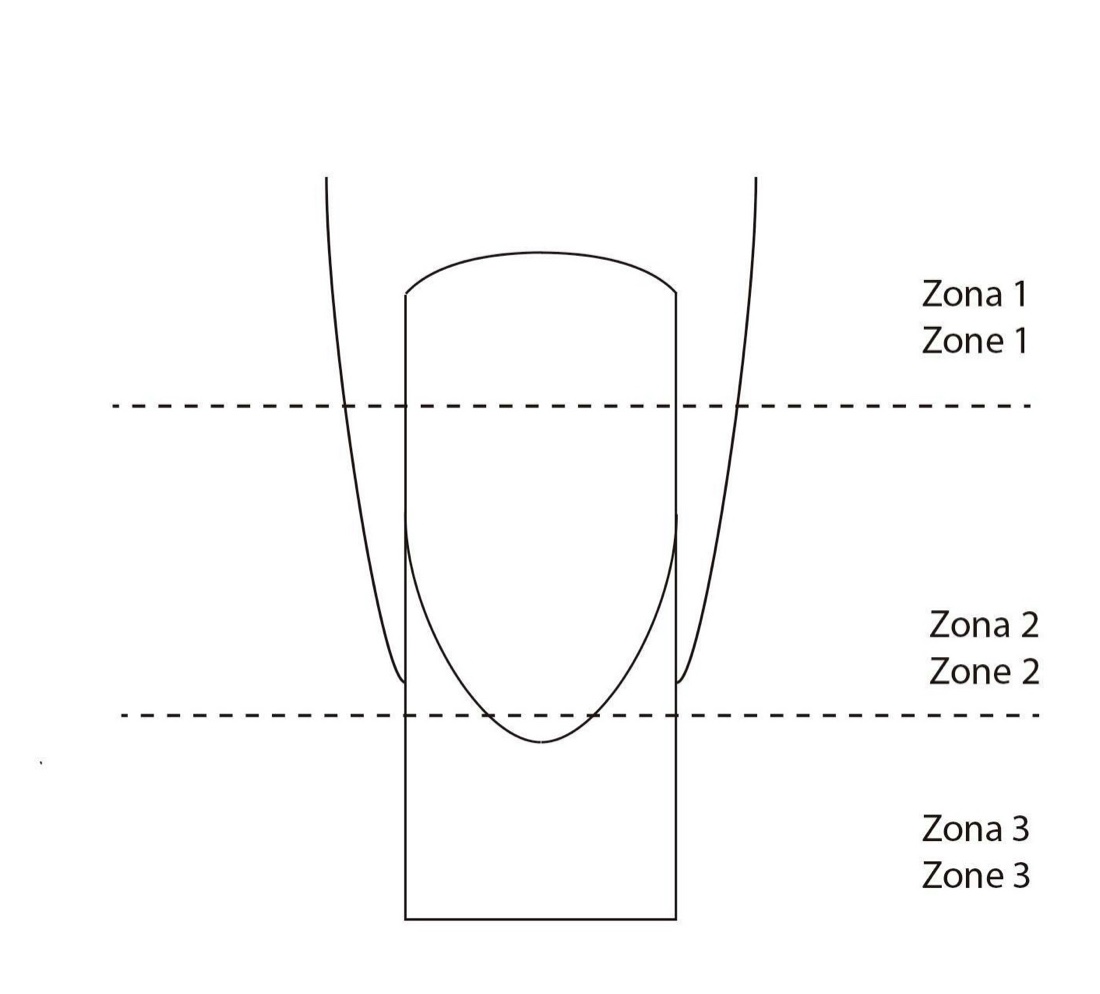
2.5.1

Rule of Nail Zones

Diagram of the nail zones
Hands-on competitions
3.3.1

French Sculptured Gel

Rules

  1. 11 hand competition. Time allowed is 1 1//2 hours (90 minutes)
  2. 2This is a competition withTraditional French style pink & white Gel nails to be created. Transparent pink, Cover Pink and/or Clear & white Gel must be used. The nails are expected to be thin (1.5mm maximum thickness in the center of the the nails Free edge where it meets between zone 2 & 3.) (See Zone Diagram). The structure is well contoured within the interior (concave) and exterior (convex), and the tip of the free edge should have a symmetric and concentric shape ( c-curve) in the structure.
  3. 3The shape is an extreme square.
  4. 4Smile lines are to be created traditionally or by reverse application for this competition. White Gel paint is not allowed to create the Smile lines.
  5. 5The competitor must use traditional Gel and sculpt the nails with forms. No tips allowed, dual or any other type of molds that can be used to create a structured shape.
  6. 6Forms are allowed to be pre-cut and prepared before the events. Metal supports are allowed. Doubling forms are allowed. Cutting forms are allowed.
  7. 7All types of Gel Sealers & Topcoats are allowed to create the shine on top of the nails.
  8. 8Cuticle oil is allowed but must be well massaged into the nail. There must not be excessive amount of oil dripping off the finger or there will be a point deduction for underside.
  9. 9All Dust needs to be well removed. Water and soap may be used to clean up. Compressed air may also be used to blow away dust.
  10. 10No glue is allowed in the Gel sculptured competition. Keep it off the table to prevent warning that can lead to a point deduction.
  11. 11Electric files are allowed, but competitors must supply their own machine, electrical cords, and adaptors.
  12. 12Electric file oil is allowed.
  13. 13Pinching tools, c-curve sticks, and all types of tools used to create a proper structure are allowed.
  14. 14Points are earned by following the criteria correctly.
  15. 15All general rules apply to this competition.
  16. 16Total points for Division 1 is 150, Division 2 is 155 & Division 3 is 160
  17. 17Criteria for this competition are as followed: Convex 10pt., Concave 10pt., Arch & Apex 10pt., Form Fit 10pt., Free-edge thickness 10pt., Sidewalls 10 pt., Lateral Side extension 10pt., C-curve 10pt., Nail Shape 10., Surface Smoothness 10pt., Length 5pt., Underside 10pt., Cuticle Area 10pt., Product Control 10pt., High Shine 10pt., Smile-line 5pt. Division 1, 10pt, division 2. 15pt. Division 3
3.6.1

Salon Style French

Rules

  1. 1Salon style French pink & white nails are to be created. This style is a shorter nail. The white application is only 1/3 of the complete nail. The application can be made with transparent or cover shaded products are allowed. These are salon style nails. The free edge may be shaped with this in consideration. The shape should be square. However, soften squared free edges are allowed. No stiletto or Almond shapes are allowed.
  2. 2The competitor may use gel, acrylic or Acrygel
  3. 3Time allowed is 1 ½ hours (90 minutes)
  4. 4Topcoat or gel sealer is allowed to create shine
  5. 5Oil is allowed.
  6. 6Water and soap may be used for clean up.
  7. 7The competitor may choose to apply with forms or tips.
  8. 8Competitors ARE ALLOWED to pre-size or cut the forms prior to the start of the competition. Doubling forms is allowed. Metal supports are allowed and can be added to the form prior to the competition
  9. 9Natural or clear tips or forms may be used. No white tips. TIPS MAY BE FIT AND PREPARED BUT NOT APPLIED PRIOR TO COMPETITION
  10. 10Gel competitors must bring their own UV/LED Gel lamp.
  11. 11Electric files are allowed, but competitors must supply their own machine, electrical cords and adaptors.
  12. 12Electric file oil and all types of buffing creams are allowed.
  13. 13Chamois style buffers are allowed both by hand or machine.
  14. 14Pinching tools, c-curve sticks and all types of tools used to create a proper structure are allowed
  15. 15The nails may be applied with the competitor's choice of Clear or Pink on the nail plate. If cover shades are used, the product should cover the entire nail plate. No transition into transparent pink at zone 1.
  16. 16Free edge and smile line may be created with white products or with Gel paint.
  17. 17UV or LED lights are allowed on the table during the competition and must be provided by the competitor.
  18. 18All general rules apply to this competition. Total points for Division 1 is 150, Division 2 is 155 & Division 3 is 160
  19. 19Criteria for this competition are as followed: Convex 10pt., Concave 10pt., Arch & Apex 10pt., Form Fit 10pt., Free-edge thickness 10pt., Sidewalls 10 pt., Lateral Side extension 10pt., C-curve 10pt., Nail Shape 10., Surface Smoothness 10pt., Length 5pt., Underside 10pt., Cuticle Area 10pt., Product Control 10pt., High Shine 10pt., Smile-line 5pt. Division 1, 10pt division 2. 15pt. Division 3
3.7.1

One Tone

Rules

  1. 11 hand competition. Time allowed is 1 hour (60 minutes)
  2. 2This is a competition with one tone or shade of color product used to create the entire application. The extension of the nail must be at a minimum of 1 cm and no longer than 1.5cm from the top of the natural nails Distal Edge.
  3. 3Gel or Acrylic sculpted nails to be created. Any type of gel or acrylic may be used.
  4. 4Cover shades or Natural should be used.
  5. 5The nails are expected to be thin (1.5mm maximum in the center of the nails Free edge where it meets between zones 2 & 3. (See Zone Diagram). The structure is well contoured within the interior (concave) and exterior (convex), and the tip of the free edge should have a symmetric and concentric shape ( c-curve) in the structure.
  6. 6The Free edge shape is extreme square.
  7. 7The competitor must sculpt the nails with forms. No tips allowed and no dual systems
  8. 8Forms are allowed to be pre-cut and prepared before the events. Metal supports are allowed. Doubling forms are allowed. Cutting the form is allowed.
  9. 9The nails should be shined with gel sealer or topcoat
  10. 10Cuticle oil is allowed but must be well massaged into the nail. There must not be an excessive amount of oil dripping off the finger, or there will be a deduction of points for the underside.
  11. 11All Dust needs to be well removed. Water and soap may be used to clean up. Compressed air may also be used to blow away dust.
  12. 12No glue is allowed in this sculptured competition. Keep it off the table to prevent warning that can lead to point deductions
  13. 13Electric files are allowed, but competitors must supply their own machine, electrical cords, and adaptors. Electric file oil and all types of bits
  14. 14Pinching tools, c-curve sticks, and all types of tools used to create a proper structure are allowed.
  15. 15Points are earned by following the criteria correctly.
  16. 16All general rules apply to this competition.
  17. 17Total possible points is the same for all divisions. 125
  18. 18Criteria rules can be located on main criteria page
  19. 19Criteria for this event: Convex, Concave, Arch & Apex, Form Fit, Free edge thickness, Side walls, Lateral side extension, C-curve, Nail Shape, Surface & Shine, Length, Cuticle area, Underside
3.8.1

Baby Boomer

Baby Boomer Competition Rules, Judges Instruction & Criteria

Rules

  1. 1Baby Boomer Style nails are to be created. The application should have an ombre effect with the use of French shades of color that graduates from cover (camouflage) shades into a white free edge.
  2. 2This is a 1 hand competition
  3. 3All shades of white and Cover pink or natural shades are allowed. Products with pearl, shimmer or other effects are allowed. Clear and transparent pink are allowed.
  4. 4Gel and acrylic are allowed to be used.
  5. 5These are salon style nails. The free edge may be shaped with this in consideration. Soft square, Coffin, ballerina, oval and Almond shapes are allowed.
  6. 6The competitor may use gel and acrylic.
  7. 7Time allowed is 2 hours (120 minutes)
  8. 8Gel sealers and top coats must be applied for shine
  9. 9Oil is allowed.
  10. 10Water and soap may be used in finishing.
  11. 11The competitor may choose to apply with forms or they can choose either Natural or clear tips
  12. 12Competitors ARE ALLOWED to pre-size or cut the forms prior to the start of the competition. Doubling of forms is allowed. Metal supports are allowed and can be added to the form prior to the competition
  13. 13Natural or clear tips or forms may be used. No white tips. TIPS MAY BE FIT AND PREPARED BUT NOT APPLIED PRIOR TO COMPETITION
  14. 14Gel competitors must bring their own UV/LED Gel lamp.
  15. 15Electric files are allowed, but competitor must supply their own machine, electrical cords and adaptors.
  16. 16Electric file oil is allowed.
  17. 17Pinching tools, c-curve stick and all types of tools used to create a proper structure are allowed
  18. 18UV or LED lights are allowed on the table during the competition and must be provided by the competitor.
  19. 19All general rules apply to this competition. Total points 95
  20. 20Criteria rules can be located on main criteria page
  21. 21Criteria for this event: Convex, Concave, Arch and Apex, form fit or tip application, Free Edge Thickness, Sidewalls, Lateral Side Extension, C.curve, Uniformity of Nail Shape, Length, surface smoothness, Underside, Cuticles Area, Product Control, High Shine Finish, , Total Impression, Level of Difficulty.
4.6.1

Salon Trend Gel

Rules

  1. 1Total time allowed is 1 hours (60minutes)
  2. 2This is a 1 hand competition
  3. 3This competition is done on natural nails only.
  4. 4The required elements for the competition are as followed.
  5. 5The model is to come with nails ready to be manicured. Models must not have ANY products one the nail when they arrive. Removing of product prior to arena evaluations are forbidden.
  6. 6The nails are to be manicured during the competition, soaking is optional. Lotion and massage is not necessary.
  7. 7All models nails will be checked to make sure manicures and filing of the nail were not done prior to the competition.
  8. 8Nails must appear to be at least 1 week without any type of manicuring.
  9. 9If it is determined that the models nails have been manicured prior to the competition a 5 point deduction can be enforced on the competitor.
  10. 10The nails must be enhanced and covered with any type of color gels, including: gel paint, soak off gel, color gel and gel polish. No traditional nail polish or any type of paints that are not considered a gel.only gel products
  11. 11The nails should have Salon style nail art with the latest trends.
  12. 12Any color is allowed. There is no limited to the amount of colors used.
  13. 13Rhinestones, studs, bullion, foil, tape and glitter and all effects are allowed
  14. 14No pre-assemble artwork allowed
  15. 15All free edge shapes are allowed
  16. 16All work on nails must be done during the competition
  17. 17No traditional nail polish.
  18. 18Top sealer must be applied
  19. 19Glue is allowed
  20. 20Rules of sanitation must be adhered too.
  21. 21All soak off gel must be clearly labeled
  22. 22All products used for manicuring are allowed.
  23. 23All products and tools must be on the table prior to the start of the competition.
  24. 24You are not allowed to get products out of your case or have product brought in from outside of the competition arena once the hands on portion of the competition.
  25. 25All General rules apply
  26. 26Total possible points earned 100

Judges Instructions

  1. 5 points total on all categories.
  2. 1 point a nail.
  3. Each nail is judged on its own merit.
  4. The nail must meet all of the criteria for the category being judged to earn its point.

Nail Shape

  1. The shape of every nail looks symmetrical. 1 point
  2. The top of the free edge is filed smoothly 1 point
  3. All free edge shapes are acceptable, but they must have symmetry.

Product Application

  1. The product surrounding the proximal nail fold must be with in 1mm and have a clean application 1 point
  2. No excessive product build up surrounding the lateral nail folds 1 point

Manicuring

  1. The proximal nail fold is pushed back and appears properly manicured
  2. All dead tissue is properly removed.
  3. Both to earn 1 point
  4. There is not excessive removal or cutting of the living tissue attached to the nail folds
  5. The nail grooves are not removed or damaged
  6. Both to earn 1 point

Underside

  1. No visible dust or debris is allowed. 1 point
  2. No glue or excessive gel products of any kind. 1 point

Surface Smoothness

  1. The surface of the nail must feel perfectly smooth. ½ point
  2. The surface of the nail must not have any air bubbles on the surface. ½ point
  3. Products that create texture is allowed to be used put must be applied with a clean presentation. Rhinestone and embellishments must not have excessive gel surrounding it. Sugar, chrome, glitters and other effects must be applied evenly.

Top Sealer Finishing

  1. The top sealer may be shiny or matte but must be applied on the entire surface of the nail. ½ point
  2. There should not be any dull spots on the surface from uncurled products and all gel residue must be well removed. The surface should not have any residual inhibition layer ½ point

Color Application

  1. The Application of the product should completely cover the surface of the entire nail.

Product must be applied evenly with no streaks. The color should look extremely solid with no transparencies. ½ point

  1. The tip of the free edge must be covered completely. ½ point

Judges Instructions for Artistic Categories

  1. Criteria is scored as a total scored
  2. All criteria points awarded are from 1-10
  3. Scores are determined by the judges educated opinion based on the specifics of each criteria

Level of Difficulty

  1. The complexity of the design is evaluated on its degree of expertise on each nail.
  2. The art should be executed in a manner that appears to be difficult on each nail.
  3. The score is based on the degree of expertise put into the making of the design on each nail.

Use of Color

  1. The colors chosen should complement the design
  2. The colors should represent the design and theme appropriately
  3. The colors should flow throughout or graduate through all 10 nails.
  4. The colors should complement and contrast at the same time.

Originality

  1. The design should be something you have not seen before.
  2. If the design is something commonly seen, it should be done in a manner that is in a new creative and unusual use of art media.

Creativity

  1. Creative use with products use.
  2. There should be a creative collaboration of art and style that is brought together.
  3. If embellishments are used, there should be a creative manner in which they are used to create the design.
5.4.1

Ultimate Nail Art Challenge

Rules

  1. 1Total time allowed is 7 hours.
  2. 2Description of the competition is a long running event where the competitor must create a set of nails that have all types of nail art including; 3D acrylic, flat art with gels and/ or acrylic paint, structured nails with unique shapes and styles on models.
  3. 3Time allowed: the competitors will have 7 hours to complete their work. The first day is 4 hours without models present while all 3d work will be created.
  4. 4The second part of the challenge is on the last day. The models will be present and there will be 2 hours to apply the nails on the 1 hand to be applied. There will be a 1-hour break for judging and the remanding 1 hour after the break will be with models present for the 3d artwork to be applied and added to the top surface. There will be a second judging.
  5. 5Flat art, foils, glitters, flocking, crushed shells, confetti and rhinestones are allowed for extra effect.
  6. 6No pre-made art such as Fimo or machine-made shapes of any kind.
  7. 7The theme is the competitors' choosing. The theme will be judged based on the cohesive collaboration of artistry and style. There is not actual theme required. For example; Alice in Wonderland. The theme should have a style and design that represents the competitor's unique style.
  8. 8The models' nails should have a unique and new modern style shape. Example; edge, stiletto, or pipe.
  9. 9The models nails may be applied with acrylic or gel but must be sculpted. All colors and types of acrylics and gel are allowed.
  10. 10The nails may be applied however the competitor chooses.
  11. 11The models' nails will be scored in the same manner as any other structured nail competitions; it has a unique shape. Example; French twist, design stiletto & design sculpture.
  12. 12Artwork may be applied into the structured nail and on the surface.
  13. 13Flat artwork of all kinds with all types of flat art mediums are allowed.
  14. 14Gel sealers and topcoats are allowed.
  15. 15Use of electric files is allowed.
  16. 16The competitor may not use any of their own pre-made work.
  17. 17All commonly used items needed for 3D sculpting are allowed. Example: wire, aluminum, pipe cleaners.
  18. 18Oil is allowed.
  19. 19Electric file oil is allowed.
  20. 20Pinching tools, C-curve sticks, and all types of tools used to create a proper structure are allowed.
  21. 21Competitors ARE ALLOWED to pre-size or cut the forms prior to the start of the competition. Doubling forms are allowed. Metal supports are allowed and can be added to the form prior to the competition
  22. 22All products and tools will be inspected by a floor judge prior to the competition.
  23. 23All general rules apply to this competition.
  24. 24Total possible points 245
  25. 25Criteria for this competition are as followed: Concave 5pt., Convex 5pt., Arch & Apex 5pt., Free-edge thickness 5pt., Sidewalls 5 pt., Lateral Side extension 5pt., Surface Smoothness 5pt., Uniformity of Shape 5pt., Length 5pt., Underside 5pt., Cuticle Area 5pt., Product Control 5pt., High Shine 5pt.,Level of Difficulty 20pt., Use of Color 20pt.Clarity of Design 20pt., Originality 20pt., 3-D Presentation 20pt., Composition 10pt., Balance 10pt., Presentation 10pt., Creativity 10pt., Continuity of Theme 10pt., Graphic Quality 10pt., Media 10pt., Overall Workmanship 10pt.,
5.7.1

French Art Stiletto

Rules

  1. This competition combines the element of French, colors and art with the technical aspect of nail structure.
  2. Competitors will be scored on a combination of technical and artistic criteria.
  3. The nails should have a traditional Stiletto shape where the tip of the nail comes to a fine point.
  4. Total time allowed for this competition is 2 hours to complete 1 hand (5 fingers)
  5. Competitor is allowed to choose to sculpt with gel or acrylic and the nails must be sculpted with forms.
  6. Tips are not allowed
  7. The nails must have a smile line with the use of cover products for the nail plate.
  8. The competitor is allowed to use products with any color and glitter for the free edge and all of the artistic element applied onto the nail.
  9. All nail our products used to create special effects are allowed. For example chrome powders, 3-D gel paint, confetti and glitters of all types. Foil or any new type of a current trend.
  10. Design work can be applied inside the application without limitation and/or on top of the nails with art that is no more than 5 millimeters in height.
  11. The smile lines must be clearly exposed on all nails
  12. The competitor may incorporate all types of paint, 3-D products and rhinestones for an added artistic element on top of the nail
  13. The nails will be scored in a similar manner as most artificial enhancement competitions.
  14. There will also be categories such as creativity, artistic design and use of color that will be scored.
  15. The application can be designed to the competitor’s desire and ability.
  16. Gel sealers or top coat must be applied
  17. Electric files are allowed
  18. Oil is allowed
  19. Electric file oil is allowed
  20. Pinching tools, c-curve sticks and all types of tools used to create a proper structure are allowed
  21. Decals or pre-assembled art of any kind is not allowed
  22. All general rules apply to this competition
  23. Total possible points for 1 hand Division 1 is 110, Division 2 is 115, and Division 3 is 120.
  24. Criteria for this competition are as followed: Concave 5pt., Convex 5pt., Arch & Apex 5pt., Free-edge thickness 5pt., Sidewalls 5 pt., Lateral Side extension 5pt., Surface Smoothness 5pt., Uniformity of Shape 5pt., Length 5pt., Underside 5pt., Cuticle Area 5pt., Product Control 5pt., High Shine 5pt., Smile-line 5pt., Creativity of Design 10pt., Total Impression 10pt., Level of Difficulty 10pt., Use of Color 10pt.

Art French

  1. 1This competition combines the element of art with the technical aspect of nail structure.
  2. 2Competitors will be scored on a combination of technical and artistic criteria.
  3. 3The nails may have ANY free edge shape. Get creative for higher score in level of difficulty
  4. 4Total time allowed for this competition is 2 hours for 1 hand
  5. 5Competitor is allowed to choose to sculpt with gel or acrylic and the nails must be sculpted with forms. Absolutely no use of dual form systems
  6. 6Tips are not allowed
  7. 7The competitor is allowed to use products with white and transparent pink or cover pink to help maintain a French presence in the overall look. Clear is allowed. All types of shimmers, effects and glitter in all colors.
  8. 8Use as many colors you want for the free edge design.
  9. 9Design work can be applied inside the application without limitation. No artwork or embellishments on the surface allowed. The nails must feel smooth on the surface.
  10. 10No embellishments of any kind inlaid into the application.
  11. 11The nails will be scored in a similar manner as most artificial enhancement competitions.
  12. 12The nails must have a distinguished appearance of a French style nail. The separation between the Nail plate and free edge has to be in a traditional smile line design. See examples
  13. 13There will also be categories such as creativity, artistic design and originality that will be scored.
  14. 14The application can be designed to the competitor's desire and ability.
  15. 15Gel sealers or topcoat must be applied
  16. 16Electric files are allowed
  17. 17Oil is allowed
  18. 18Electric file oils are allowed
  19. 19Pinching tools, c-curve sticks, and all types of tools used to create a proper structure are allowed
  20. 20The natural nail may be prepared up to the primer application
  21. 21Competitors ARE ALLOWED to pre-size or cut the forms prior to the start of the competition. Doubling of forms is allowed. Metal supports are allowed and can be added to the form prior to the competition
  22. 22Decals or pre- assembled art of any kind is not allowed
  23. 23All work must be created at the time of the competition
  24. 24All general rules apply to this competition
  25. 25Total possible points earned: 120.
  26. 26Criteria for this competition are as followed: Concave 5pt., Convex 5pt., Arch & Apex 5pt., Smile line:15 pt., Free-edge thickness 5pt., Sidewalls 5 pt., Lateral Side extension 5pt., Surface Smoothness 5pt., Uniformity of Shape 5pt., Length 5pt., Underside 5pt., Cuticle Area 5pt., Product Control 5pt., High Shine 5pt., Creativity of Design 10pt., Total Impression 10pt., Level of Difficulty 10pt., Originality 10pt.
Submitted competitions
6.1.2

Submitted Nail Art — General Rules

Submitted Nail Art General rules.

  1. 1The competitor is not allowed to use copyrights elements. For example: Disney, Warner bros, Sanrio, Alice in Wonderland MOVIE characters
  2. 2All entries may be submitted for any of the INJA competitions multiple times. Once the entree has taken 1st, 2nd or 3rd place in any division at any of the INJA competitions, it can not longer be submitted for a new competition.
  3. 3No repeat trophied entries from past years are allowed.
  4. 4Pictures will be available from past competitions for judge’s reference.
  5. 5Artwork will be prepared and finished by the competitor prior to the competition.
  6. 6Every competitor should be prepared to verbally explain how something was created, if asked by the judges.
  7. 7Competitors may only submit their own work that they do by hand.
  8. 8All entrees may be questioned and the competitor asked to recreate a portion of the work submitted as proof.
  9. 9The tip/s may be bought or made. If the tips are create by hand, they must have the same proportions and c-curve as commercial tips
  10. 10All entries must be presented at the time scheduled for the organization and left at the competition until after the close of the competition and award ceremony with the exception of fantasy nail art.
  11. 11No entries left after the close of the competition will be returned. It is the competitors’ responsibility to pick up their work at the designated time and place.
  12. 12All entries, except fantasy on model,  may be accompanied by a typed description of the work involved, including what types of nail art media were used. The description must be written in both English and the native language of the hosting country that the art is entered in.
  13. 13The descriptions must be attached to the box( not apart), short, easy to read.
  14. 14Having a display any larger may result in the competitors entree not being displayed and if it is too large, it may not be accepted or get 5 points deduction. This is left to the discretion of the head judge.
  15. 15Maximum of 1 submission for each competition per competitor
  16. 16You must be present to enter the Competition.
6.1.3

Submitted Art — Criteria & Art Definitions

SUBMITTED ART CRITERIA

Color theory

Use of Color or chromatic analysis

  1. How the color theory has been applied.
  2. Emphasis helps to see the definition of artwork
  3. The hues of colors chosen should complement the design and flow throughout or graduate through all nails/objects.
  4. Value has been applied, using dark and light.

Graphic Quality

  1. The texture of the design is done perfectly to represent the style chosen.
  2. Use of art mediums must be used to create emphasis and texture.
  3. If there is Line or details in the artwork, the space and shape must be well defined

Media

  1. There must be a minimum of 3 art mediums used on every nail.
  2. The mediums should be used to represent harmony in a creative manner.
  3. The mediums should be used for gradation to accent the artwork
  4. Each media will receive 1/3 of the score. If 4 or more mediums are used the score will be divided appropriately

Total impression

  1. The first impression of the artwork in its entirety
  2. The artwork should attract your vision, compelling you to give more attention to the artworks detail.

Workmanship

  1. The ability to represent all the artistic elements properly, with a clean appearance.
  2. There should not be any visible imperfections in the construction of the artwork. For example, fingerprints into the paint, glue resin on embellishments. Excessive amount of gel. Dust that was not properly removed are all considered poor workmanship

Level of Difficulty

  1. The complexity of the design is evaluated on its degree of expertise.
  2. Is the art executed without any elaboration (simple) or is there more difficulty and expertise put into the making of the design.

Composition

  1. How the artwork is proportioned
  2. The design should have movement from each nail so that the eye is drawn from nail to nail.
  3. The nails represent the artwork individually while also representing the artwork in its entirety
  4. Different dimensions within the artwork, depending on the placement of each piece as the completed scene.

Balance

  1. The design should not be too busy or too sparse.
  2. The art should look evenly balanced on each nail and from nail to nail.
  3. There should not be large portions on the surface of the nail left without design.
  4. The combination of artistic elements adds a feeling of equilibrium or stability to the artwork

Continuity of Theme

  1. The theme should be carried through the design in some manner on each nail.
  2. The design should complement and have continuance from nail to nail while representing the theme.

Clarity of Design

  1. The design must be apparent and identifiable.
  2. Is there intensity that enhances the clarity on each nail?
  3. All the artistic representation must be presented in a manner that is identifiable.

Originality

  1. The theme or design should be something you have not seen before or an original interpretation of artwork that is commonly seen.

Creativity

  1. Creative use of art mediums.
  2. There should be a creative collaboration of art mediums that are used.
  3. It should be a creative interpretation of design

Presentation

• The design appears completely finished on each nail

• No artwork was left unfinished. Artwork that wasn't finished being completely executed Example: face with no lips or eyes, car without the tires, dog without a tail

3-D Presentation

• There should be artistic form present on each nail

• The 3D form should be presented with clean application

• The 3D form should be created with unique style and shape

  1. The form should have texture

Rhythm

  1. A principle of design indicates movement was created by the careful placement of repeated elements in the work of art to cause a visual tempo or beat

Variety

  1. A principle of design concerned with diversity or contrast.
  2. Variety is achieved by using different shapes, sizes, and colors in a work of art.

ART DEFINITIONS

Balance: The way of combining elements to add a feeling of equilibrium or stability to a work of art. Major types are symmetrical and asymmetrical.

Emphasis: (contrast) A way of combining elements to stress the differences between those elements

Proportion: A principle of design that refers to the relationship of certain elements to the hall into each other

Gradation: A way of combining elements by using a series of gradual changes in those elements. (Large shapes to small shapes, dark hues to light hues, etc.)

Harmony: A way of combining similar elements in an artwork to accent their similarities (achieved through use of repetitions or settle gradual changes)

Movement: A principle of design used to create the look and feeling of action and to guide the viewers' eyes throughout the work of art.

Line: an element of art defined by a point moving in space. Line may be two or three dimensional, descriptive, implied, or abstract.

Shape: an element of art that is dimensional, flat, or limited to height and width.

Form: an element of art that is three dimensional and then encloses volume; includes height, width AND depth (as in a cube, a sphere, A pyramid, or a cylinder) Form may also be free flowing

Value: The lightness or darkness of tones or colors. White is the lightest value. Black is the darkest value. The value of halfway between these extremes is called middle gray.

Space: An element of art by which positive and negative areas are defined or a sense of depth achieved in a work of art.

Color: an element of art made up of three properties; hue, value, and intensity.

Hue: name of color

Intensity: Quality of brightness and purity (high intensity= color is strong and bright low intensity= color is faint and dull)

Texture: An Element of art that refers to the way things feel or look as if they might feel if touched.

6.2.1

Mixed Media

Rules

  1. 1Mixed Media Box Art is a submission type competition.
  2. 2The tips may be bought or made. If the tips are create by hand, they must have the same proportions and c-curve as commercial tips.
  3. 3The tips may be connected together or displayed separately.
  4. 4If 10 tips are to be created they must reflect different nail sizes, as real nails do. Anyone using all one size tips will have an automatic 5 point deduction to their final score. The tips may be any length and shape.
  5. 5Competitors must use 3 art media: 1. Mediums for painting, example: Micro painting, Air Brush, Water Paint, Gel Paint, Acrylic paint, Polish 2. Mediums to build 3D artwork, example: Acrylic,Color powder, Gel, Gel Pasta 3. Nail art embellishments, example: Rhinestones, pearls, bullion, foils and crushed shells.
  6. 6Failure to use 1 of each type of media will result in a 5 point deduction.
  7. 7All 3 media used must be used in an artistic way, or they will not count towards the required 3 nail art media.
  8. 8All of the nail art applied to the actual tips, whether attached to the tip or not, will count & must not extend further than 1 cm from the nail surface or 5 points will be deducted from the final score.
  9. 9No decals or stamping allowed. No molds (pre cast embellishments) to create art shapes

allowed.

  1. 1The artwork for this competition will be judged as a compete portrait. One completed composition.
  2. 2The artwork should have all types of artistry of all styles and creativity.
  3. 3There should be a strong theme presented in the artwork
  4. 4Total possible point is 110.
  5. 5The maximum score given for each of the 10 criteria judged for this competition are: Level of difficulty 20pts, Balance 10pts, Composition 10pts, Originality 10pts, Media 10pts, Graphic Quality 10pts, Continuity of theme 10pts, Clarity of design 10pts, Color Theory 10pts, Workmanship 10pts
6.3.1

Flat Art Tip Box

Rules

  1. 1Flat Art Tip Box is a submission competition
  2. 2The tips must be connected together to create a canvas for the artwork
  3. 3Competitors may use the following nail art media: airbrushing, acrylic paint, color gels and paints, nail polish.
  4. 4The art media must be used in an artistic way
  5. 5All hand painting techniques are allowed but the artwork must be completely flat.
  6. 6NO nail art embellishments such as Rhinestones, pearls, bullion, foils and crushed shells.
  7. 7No decals or any kind. No stamping of any kind
  8. 8The artwork for this competition will be judged as a compete portrait. One completed

composition.

  1. 1The artwork may have all types of artistry and all styles and creativity.
  2. 2There should be a strong theme presented in the artwork
  3. 3Total possible points is 100
  4. 4The maximum score given for each of the 10 criteria judged for this competition are: Level of difficulty 20pts, Balance 10pts, Composition 10pts, Originality 10pts, Media 10pts, Graphic Quality 10pts, Continuity of theme 10pts, Clarity of design 10pts, Color Theory 10pts,
6.4.1

Fantasy Nail Art

Rules

  1. 1Fantasy Nail Art is considered a submitted art competition because the artwork is prepared prior to the competition and then presented on a model at the time of the event.
  2. 2The model must be complete with the costume, make-up, and nails on. The model should be finished and ready to judge when they arrive.
  3. 3It is not necessary for the competitor to be present during the actual judging. Competitors that are competing in other competitions during the time of judging May choose to present their model and then leave them for judging so that they can still compete in the hands-on competition taking place at the same time.
  4. 4Only the model and competitor are allowed on the competition floor for judging.
  5. 5Competitors may use all types of products used in the nail industry.
  6. 6Artwork must be on every finger.
  7. 7The tips do not need to be glued onto the models' nails. Clips are allowed to help support the artwork on the model to prevent the need for glue.
  8. 8Competitors may use items to help create the 3D figures. Wire, netting, balloons or anything that helps to build out the artwork except molding clays.
  9. 9Three-dimensional, pre-cast embellishments, feathers, decals, gems, accessories, ornaments, or any form of fantasy is allowed. That includes LED lights or electrical parts. Anything to add to the artwork.
  10. 10The artwork should be displayed on every nail.
  11. 11There are no limitations as to how large the artwork can be.
  12. 12Keep in mind that the costume is a large part of this competition. It should represent the theme of the artwork.
  13. 13The artwork should have all types of artistry of all styles and creativity.
  14. 14There should be a strong theme presented in the artwork
  15. 15The total possible point is 140.
  16. 16The maximum score given for each of the 12 criteria judged for this competition are: Level of difficulty 20pts, Composition 10pts, Balance 10pts, Color Theory 10pts, Continuity of theme 10pts, Graphic Quality 10pts, Clarity of Design 10pts, Originality 10pts, Workmanship 10pts, Creativity 10pts, 3-D Presentation 20pts, Costume 10pts

Costume

  1. How well is the costume presented
  2. It should portray the theme well.
  3. This criteria is scored based on your opinion on how well the costume was put together and how well it represents the theme.
6.5.1

Salon Trend Pedicure

Rules

  1. 1Salon trends pedicure tip art is a submission type competition.
  2. 2Artwork is to be designed on toenail tips and mounted and placed on a black board
  3. 3The tips must be displayed separately. Do not attach them together.
  4. 4A full set of 10 TOENAIL tips with a maximum length of 2cm must be used to create the artwork and must reflect different nail sizes, as real toenails do. Example of a good tip size range: larger size 0 or 1. The middle tips 2,3 or 4 and the smallest size 5. Anyone using all one size tips will have an automatic 5-point deduction to their final score.
  5. 5Competitors may use the following nail art media: ALL Gel products, ALL Acrylic products, ALL types of painting (Micro art), Polish. Nail art embellishments such as Rhinestones, pearls, bullion, foils, and holograms may be used. Chrome and pearl dust, any nail art effect offered for nails.
  6. 6No decals of any kind are allowed. Stamping is allowed.
  7. 7The artwork for this competition will be judged as a "salon trend." The judges expect to see artwork that you would see in the salon.
  8. 8The artwork should have a design and current trend.
  9. 9There is no score for the theme in this competition. It should NOT have a theme or have artwork that has murals or pictorial style artwork. The judges will maximize the score given if the artwork is too extreme for salon work.
  10. 10Total points are 100.
  11. 11The maximum score given for each of the 9 criteria judged for this competition are: Level of difficulty 20pts, Color theory 10pts, Creativity 10, Rhythm 10pts, Total impression 10pts, Graphic Quality 10pts, Balance 10pts, Workmanship 10pts, Variety 10pts
6.6.1

Fantasy Nail Art Tip Box

Rules

  1. 1Fantasy Nail Art tip box is considered a submitted art competition.
  2. 2All artwork must be attached onto 1 nail tip as the base. Any tip length and shape are acceptable.
  3. 3The artwork may be as large as the competitor chooses, but it must fit into the proper size box.
  4. 4Covered displays may be bought or made. Boxes should not be any larger than 25 centimeters in dimension. And 20 centimeters in height.
  5. 5Competitors may use all types of products used in the nail industry.
  6. 6Competitors may use items to help create the 3D figures. Wire, netting, balloons, or anything that helps to build out the artwork except molding clays.
  7. 7Three-dimensional, pre-cast embellishments, feathers, decals, gems, accessories, ornaments, or any form of fantasy is allowed. That includes LED lights or electrical parts. Anything to add to the artwork.
  8. 8The artwork should be 3D artwork
  9. 9The artwork should have all types of artistry of all styles and creativity.
  10. 10There should be a strong theme presented in the artwork
  11. 11The total possible point is 120.
  12. 12The maximum score given for each of the 11 criteria judged for this competition are: Level of difficulty 20pts, Composition 10pts, Balance 10pts, Color Theory 10pts, Continuity of theme 10pts, Graphic Quality 10pts, Clarity of Design 10pts, Originality 10pts, Workmanship 10pts, Creativity 10pts, 3-D Presentation 10pts,
6.8.1

Salon Trend Manicure Tip Box

Rules

  1. 1Salon trends Manicure tip art is a submission type competition.
  2. 2Artwork is to be designed on Fingernail tips and mounted and placed on a black board
  3. 3The tips must be displayed separately. Do not attach them together.
  4. 4A full set of 10 Fingernail tips with a maximum length of 2cm must be used to create the artwork and must reflect different nail sizes, as real fingernails do. Example of a good tip size range: larger size 0 or 1. The middle tips 2,3 or 4 and the smallest size 5. Anyone using all one size tips will have an automatic 5-point deduction to their final score.
  5. 5Competitors may use the following nail art media: ALL Gel products, ALL acrylic products, ALL types of painting (Micro art), Polish. Nail art embellishments such as Rhinestones, pearls, bullion, foils, and holograms may be used. Crome and pearl dust, any nail art effect offered for nails.
  6. 6No decals of any kind are allowed. Stamping is allowed.
  7. 7The artwork for this competition will be judged as a "salon trend." The judges expect to see artwork that you would see in the salon.
  8. 8The artwork should have a design and current trend.
  9. 9There is no score for the theme in this competition. It should NOT have a theme or have artwork that has murals or pictorial style artwork. The judges will maximize the score given if the artwork is too extreme for salon work.
  10. 10Total points is 100.
  11. 11The maximum score given for each of the 9 criteria judged for this competition are: Level of difficulty 20pts, Color theory 10pts, Creativity 10, Rhythm 10pts, Total impression 10pts, Graphic Quality 10pts, Balance 10pts, Workmanship 10pts, Variety 10pts
6.9.1

Rhinestone Art Color Tip Box

Rules

  1. 1Rhinestone art is a competition that is a submitted art classification.
  2. 2Cover tips should be used with a square or an oval shape.
  3. 3The length of the tip should not exceed 1.2 inches ( 3.04 cm)
  4. 4The tips must be separate and cannot be connected together
  5. 5There is no theme scored for this competition
  6. 6You must use multiple color rhinestones used for this competition.
  7. 7Various shapes and sizes of rhinestones should be used
  8. 8Micro beads and bullions may be used. But only as accents of up to 20% of the artwork.
  9. 9Complete work must be under 5 mm in height and cannot exceed 5 mm
  10. 10from nail base.
  11. 11Base nails should only be painted in one color. (Color with glitters is allowed.)
  12. 12Polishes or color gel (polish gels) may be used.
  13. 13Gel sealers, topcoats and glue are allowed for adhesion of the rhinestones
  14. 14The total score is 90.
  15. 15The maximum score given for each of the 8 criteria judged for this competition are: Level of

difficulty 20pts, Color theory 10pts, Creativity in design 10pts, Total impression

10pts, Balance 10pts, Workmanship 10pts, Rhythm 10pts, Variety 10pts

Creativity in Design

  1. The placement of the rhinestones should represent a unique pattern that represents a design
6.10.1

Living Art

Rules

  1. 1Living Art is considered a submitted art competition.
  2. 2All artwork must be applied to an alternative decorative surface. For example: pins, brooches, key holders, plates, phone covers.
  3. 3The artwork may be no larger than 10cm in height
  4. 4Artwork shall be attached to a black board or box. Boards and boxes should be no larger than 20x14cm
  5. 5Competitors may use all nail art mediums.
  6. 6Competitors must use a minimum of 3 art mediums and techniques. Failure to use 3 will result in a 5 point deduction.
  7. 7Nail art embellishments such as Rhinestones, pearls, bullion, foil, metal ornaments are allowed
  8. 8The design shall not change the original use or nature of the base product (decorative surface)
  9. 9The artwork should be a combination of artistry
  10. 10The artwork should have all types of artistry of all styles and creativity.
  11. 11There should be a strong theme presented in the artwork
  12. 12Total possible point is 110.
  13. 13The maximum score given for each of the 10 criteria judged for this competition are: Level of difficulty 20pts, Composition 10pts, Balance 10pts, Color Theory 10pts, Continuity of theme 10pts, Graphic Quality 10pts, Clarity of Design 10pts, Originality 10pts, Workmanship 10pts, Media 10pts

Posters

Rules, Criteria & Instructions for Competition Judges

Competition rules

  1. 1Poster is a submitted competition.
  2. 2The photo must be done in high resolution
  3. 3The poster must be printed in A4 format
  4. 4The nails photographed must be clearly visible and representative structure and salon nail art.
  5. 5They don't have to be long nails
  6. 6The nail art that will be performed must be easy and quick to create but the original
  7. 7Only one hand must be photographed, in the foreground so that the work is clearly visible
  8. 8Competitors are allowed to use the following nail art media: all types of gel, all types of acrylic, all types of paint (micro-painting), nail polish. The use of nail art decorations such as rhinestones, pearls, precious metals, foils and holographic colors is also permitted. Chrome colors and pearl powder, every type of nail art created for your nails.
  9. 9No decals of any kind are allowed in the competition. Stamping is allowed
  10. 10Entry for this competition will be judged as salon nail art. Judges expect to see work that they would see in a salon. There are no scores for the theme in this competition. It should not be themed or have a workmanship like a mural or painting style. If the work is too extreme for the salon the judges will lower the maximum score a criterion can get.
  11. 11The maximum total score is 100
  12. 12The criteria judged for this competitions are: level of difficulty 20pt, color theory 10pt, creativity 10pt, photo quality 10pt total impression 10pt, graphic quality of the work performed 10pt, balance 10pt, final impression 10pt, variety 10pt

Tip Portrait

Rules, Criteria & Instructions for Competition Judges

Competition rules

  1. 1Tip Portrait is a submitted competition
  2. 2The work must be displayed on a single tip
  3. 3The tip must represent a portrait of a human face or an animal and be accompanied by a photo of the person or animal being portrayed
  4. 4The work must be accompanied by a written description
  5. 5Competitors may use the following media for nail art: airbrush, paint acrylic, gel color and paint, nail polish.
  6. 6Artistic media must be used in an artistic way.
  7. 7All painting techniques are permitted but the work must be completely flat.
  8. 8Nail art such as rhinestones, pearls, bubbles, foil and pieced shells are not allowed.
  9. 9No decals or anything like that are allowed. No stamping is allowed.
  10. 10The artwork for this competition will be judged as a portrait.
  11. 11Art work can have any type of artistry on any style and creativity
  12. 12Total possible score 90 points

highest score given for each of the 10 criteria judged for this competition are: level of difficulty

20pt, balance 10pt, composition 10pt, Originality 10pt, media 10pt, graphic quality 10pt, clarity of design 10pt, color theory 10pt, final impression 10p

Extreme Stiletto

Stiletto – Extreme Sculpture

Create beyond the ordinary. Sculpt beyond the limits.

This is an advanced competition category created for nail artists who want to demonstrate exceptional skill in extreme nail architecture, sculpting, technical precision and creative nail design.

The objective is to create one extraordinary extreme stiletto nail that demonstrates a high level of technical ability while maintaining a clearly recognizable, balanced and beautifully constructed nail architecture.

This category is not simply about creating the longest or most decorated nail.

The winning entry should demonstrate:

Extreme Architecture + Technical Mastery + Creativity + Precision + Visual Impact

Each competitor may enter ONE nail only.

The presentation must clearly show the nail as a single competition nail.

The finished nail must measure more than 5 inches / 12 cm, measured from the cuticle area to the free edge/tip.

The length must be incorporated into the overall architecture and must not simply be added for visual effect.

The finished nail must clearly demonstrate a stiletto foundation.

Competitors may interpret the stiletto creatively and may incorporate advanced architectural elements, but the fundamental stiletto character must remain visible.

This category encourages competitors to push the boundaries of nail architecture.

Advanced architectural techniques may include:

  1. extreme length;
  2. dramatic C-curves;
  3. advanced apex placement;
  4. sculptural architecture;
  5. dimensional structure;
  6. negative space;
  7. encapsulated architecture;
  8. layered construction;
  9. advanced shaping techniques;
  10. technically demanding structural elements.

A larger or more complicated structure does not automatically receive a higher score.

Competitors have complete artistic freedom regarding the design.

The design may include:

  1. 3D elements;
  2. encapsulation;
  3. crystals;
  4. rhinestones;
  5. bullion;
  6. pigments;
  7. glitter;
  8. foil;
  9. texture;
  10. sculpted elements;
  11. mixed-media techniques;
  12. optical effects;

The design may be placed:

  1. on top of the nail;
  2. underneath the nail;
  3. within the structure;
  4. along the side;
  5. around the architectural elements.

The design must remain integrated with the nail and should complement the architecture.

3D elements are permitted.

Large figurines or decorative objects that completely replace or obscure the nail architecture are not the objective of this category.

If decorative elements substantially prevent judges from assessing the architecture, points may be deducted.

Permitted materials include:

  1. Acrylic
  2. Gel
  3. Acrygel
  4. Builder Gel
  5. Colour products
  6. Pigments
  7. Glitter
  8. Foils
  9. Crystals
  10. Rhinestones
  11. Bullion
  12. Encapsulation materials
  13. Other professional nail-art material

The following are prohibited:

  1. 1Pre-made architectural components.
  2. 2Nail moulds used to create the finished competition nail.
  3. 33D printed nail-art elements.
  4. 4Pre-made figurines.
  5. 5Ready-made sculptures.
  6. 6Covering small objects with gel or acrylic to create decorative elements.
  7. 7Any technique intended to disguise the use of a prohibited pre-made element.

Judges may inspect materials or the working process if necessary.

Any competitor found deliberately using prohibited pre-made elements may be disqualified.

The entry must be the competitor’s own original creation.

The work must not have:

  1. previously won in another competition;
  2. been published as a finished competition entry on social media;
  3. been published in a magazine or journal;
  4. been publicly exhibited as a completed competition piece;
  5. been copied from another artist’s work.

The competitor may draw inspiration from fashion, nature, architecture, art, culture or other sources.

The final work must represent the competitor’s own creative interpretation.

The display system should allow judges to inspect the nail from multiple angles.

The nail must be accessible for:

  1. front view;
  2. rear view;
  3. top view;
  4. side view;
  5. underside;
  6. tip;
  7. C-curve;
  8. apex;
  9. sidewalls;
  10. overall architecture.

The nail must not be permanently fixed to a flat surface in a way that prevents complete inspection.

The presentation should be clean, professional and neutral ( black board )

All general rules apply to this competition

The category is judged out of 110 points.

The maximum score given for each of the 10 criteria is: 10pt nail shape, 20pt level of difficulty, 10pt creativity, 10pt color theory, 10pt graphic quality, 10pt originality, 10pt total impression, 10pt Media, 10pt finishing,10 pt 3D presentation

© 2016 INJA — International Nail Judge Association. All rights reserved.